MKS INSTRUMENTS MECHANICAL/ELECTRICAL ENGINEERING INTERNSHIP.
The Boston University Mechanical Engineering department doesn’t have the equipment to physically demonstrate compressible flow and propulsion principles to students interested in aerospace and compressible fluids. Therefore, students don’t have the opportunity to interact with physical systems and learn how propulsion systems change throughout a Brayton Cycle and react under different parameters. Creating a demonstration of the Brayton Cycle would give students valuable experience with a system that they may work with in the future.
Our customer requested the design of a gas turbine engine with an instrumentation system for a laboratory environment and an electric motor/generator unit (MGU) that would aid in the startup and power generation.
AWARDS: BEST PROJECT IN "AEROSPACE"

May 2, 2024
INFORMATION
Professor Anthony Linn
Client
Advisor Professor
Professor Frank Di Bella
Location
Boston University, MA
Date
9/5/23 – 5/2/24
Teammates
Nathan Lau
Jason Cruz
Noel Cummings
(contributions from Hector Castro Noguez)
Programs Used
EMWorks (MotorWizard)
GibbsCAM (CNC Machining)
MATLAB
Rocket Propulsion Analysis (RPA)
SimFlow CFD
SolidWorks
SolidWorks Flow Simulation

Overview
For a design purposed for lab work, the gas turbine design was intended to be portable. The frame was designed with 2020 aluminium extrusions on heavy-duty casters for which crucial load-bearing components would be attached to. As the turbocharger was the main focus of the project, its placement and orientation purposefully placed on top of the cart with the exhaust directed upward for safety reasoning.
The system would be controlled using software connected by an "umbilical cord" containing power and data lines. This was a deliberate design choice as to distance the operators from the device for safety reasons.
Multiple fluid lines (including water, oil, fuel, and compressed air) was designed to be independently circulated with radiators and pumps providing thermal and mechanical control as well as lubrication for the turbocharger.
Garrett Turbocharger
Provided by the client of this project, a Garrett GT3788VA Turbocharger from a 6.6L diesel engine started as the basis of this project. The requirements of the turbo including the pressure, heat, operating temperatures, etc determined the sizing of the combustion chamber, radiators, compressed air system, and overall packaging of the cart.
By analyzing a Garrett compression map most similar to the provided turbo, a desired performance conditions were chosen with consideration to the limitations over the necessity of expensive high tolerance parts for safe operation. This meant reducing the target RPM from a maximum of over 100,000 RPM to just under 70,000 RPM which reduced the fuel flow and required inducer pressure thereby decreasing thermal and mechanical stresses on any modified components.
Combustion Chamber
The combustion chamber was designed to replace the combustion engine that the provided 6.6L diesel turbocharger was taken from. The design comprises of an inner flame tube with section dilution holes for the compressed air to interact with propane fuel inside. The outer combustion chamber features a choke leading to the throat with an inlet from the turbocharger compressor.
The flame tube is comprised of three zones: primary, secondary, and tertiary. The primary zone exists near the fuel injector and consists of multiple tiny holes which restricts high velocity flow from burning out the flame too quickly as well as micro-mixing of the fuel and air. The secondary zone introduces more air inside the inner tube to reduce incomplete combustion. Finally the tertiary zone features large holes to cool the expanding gasses to prevent heat damage to the componentry. The exact dimensions and count of the holes in each zone is calculated based off the inducer diameter of the provided turbocharger. Iterations can be made to improve the performance of the combustion chamber through proper testing. These calculations of the flame tube geometry can be seen in the gallery.
Currently, only CFD simulating the airflow from the compressor has been calculated. The goal was to ensure the air dilution into the flame tube would not blow out the flame while ensuring a proper 15:1 air/fuel ratio was met.


Cart Assembly (revision 1)

Rendered Cart Assembly
Cart Assembly Overview


Garrett Gt3788VA Turbocharger

Combustion Chamber (closed)

Combustion Chamber (section view)
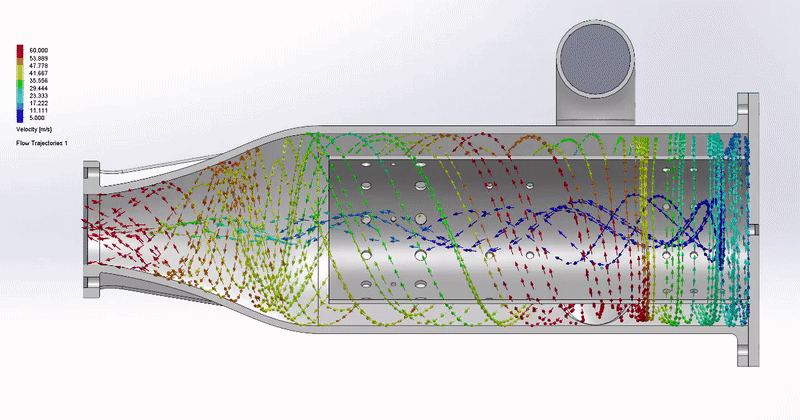
CFD Simulation Animation (outer)
Combustion Chamber (closed)
Combustion Chamber (closed)
Combustion Chamber (section view)
CFD Simulation Animation (outer)
Combustion Chamber (closed)
Combustion Chamber Design
Pulley Shaft Reduction
To generate electrical power from the turbocharger shaft (running at ~70,000 RPM), a gear reduction was necessary to run the chosen 10HP electrical generator at its rated speed (~3600 RPM). Shafts connecting to the turbocharger and the electric generator were designed with a keyed fitting.
To achieve an appropriate RPM reduction, a dual pulley design instead of a single pulley to prevent excessive pulley slack and tensioning as well as packaging constraints. Two ~1:4 ratio pulleys were analyzed to not exceed a tension ratio of 5 (deemed as a safe metric). This means one side of the pulley does not exceed a tension force 5x greater than the opposing side.

Dual Motor Pulley (assembly)

Dual Pulley (RPM ratio)

Induction Motor (10HP, 3600 RPM)
Dual Motor Pulley (assembly)
Dual Pulley & Power Generation
SCALE-MODEL COMBUSTION CHAMBER
As simulation tools are not available to accurately analyze the performance of the flame tube design on metrics of efficiency or energy output, constructing at least a scaled model will help to give a better understanding of the combustion process. Thus, with a budget of ~$300, a clear combustion chamber with a quartz glass flame tube was modelled off of the specialised flame tube design seen in previous sections.
The transparent nature of the prototype was designed to be analyzed under the view of a camera to better understand the interaction of the high velocity air flow and the inner flame tube. The nozzle type is a wide 20° spray injection linked to a quick disconnect fitting for the propane source (the same intended for the full scale build). The upper fitting is meant for a compressed air source of at least 100 PSI to supplement for the compressor of the turbocharger. The threaded rods link the two carbon steel plates meant to be removable in the event of testing multiple quartz glass flame tube designs. Unfortunately, due to the brittleness of quartz glass as well as the scale (1:3) compared to the full scale model, the holes are not to scale but are represented in their localized dimension and location.
A scale model and a test operation was conducted to visually represent the capabilities of this design of a combustion chamber. Unfortunately, only preliminary test run was done without performance optimizations to the fuel or air flow. For a performance metric comparison of various designs, a mock instrumentation system with pitot tubes and air flow meters are needed to find the optimal flame tube design.

Quartz Glass Flame Tube

Scale Combustion Chamber

Quartz Glass Tube Machining
Quartz Glass Flame Tube
Scale Combustion Chamber
Combustion Chamber Demonstration Video